
mikhail kalashnikov
$999.99
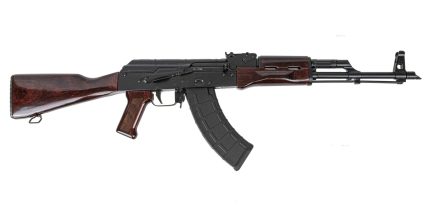
Details
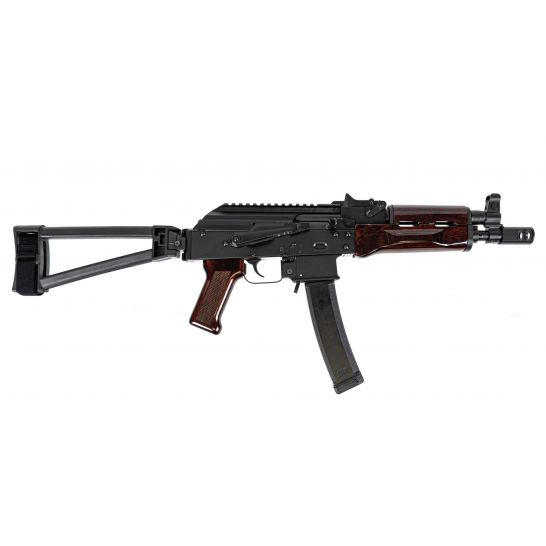
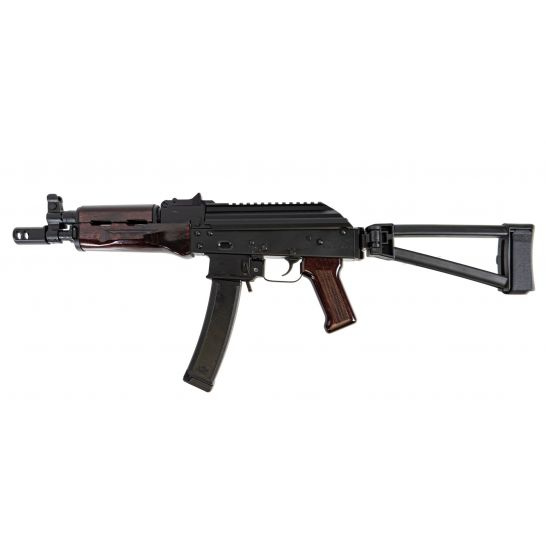
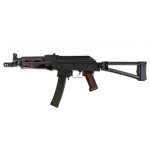
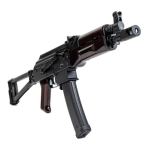
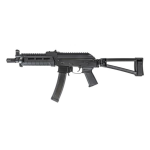
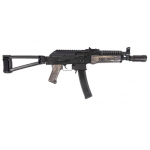
Forged Front Trunnion
Forged Bolt/Carrier
Stamped 1mm Steel Receiver
10.5″ Nitrided 4150 Steel Barrel
9x19mm
1 in 10″ Twist
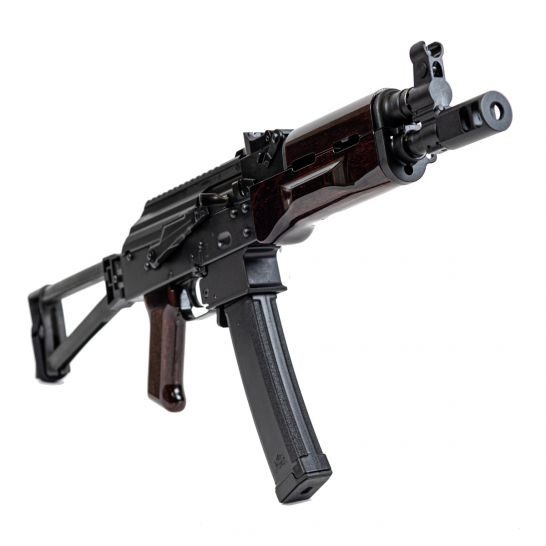
2 Port “Tanker Style” Muzzle Brake
Picatinny Top Railed, Hinged Dust Cover
Fixed Rear Sight
Enhanced Extended Safety Lever
Fire Control Group: Single Stage, Single Hook
Plum Gloss Checkered AK grip
Plum Gloss Upper/Lower Handguard
PSA AK Picatinny Stock Adapter with Triangle Side Folding Brace
U9 35 Round Patterned Magazine (Will also work in CZ Scorpion 9mm Firearms)
AKV w/ Triangle Brace Extended: 27.5″
AKV w/ Triangle Brace Folded: 18″
**If you plan to shoot the AK-V while suppressed: Palmetto State Armory recommends using a jam nut to index, as there is not a shoulder on the barrel.**
Mikhail Kalashnikov: Life, AK-47, Career & Legacy
Who Was Mikhail Kalashnikov?
Mikhail Kalashnikov was a Soviet firearms designer best known for creating the AK-47.
Born in 1919, Kalashnikov began his career as a soldier and tank mechanic. His interest in engineering later led him into weapons design. After being wounded during World War II, he focused more closely on small-arms development.
His most famous design became the AK-47. The Soviet Army accepted the rifle in 1949, and it later became one of the most widely recognized firearms in the world.
However, Kalashnikov’s career involved much more than one rifle. He continued developing firearms for decades and helped create a wider family of weapons based on his designs.
Mikhail Kalashnikov Early Life
Mikhail Timofeyevich Kalashnikov was born on November 10, 1919, in Kurya in the Altai region.
He grew up in a large family. From an early age, he showed an interest in machinery and mechanical systems.
After leaving school, Kalashnikov worked in mechanical roles before entering military service.
His technical ability eventually helped him move toward weapons-related engineering.
The Smithsonian archives record that Kalashnikov completed secondary school in 1936 and entered the Soviet Army in 1938.
Mikhail Kalashnikov and the Soviet Army
Kalashnikov joined the Soviet Army in 1938.
He trained as a tank mechanic and later served as a tank commander. His military experience gave him direct knowledge of the equipment used by soldiers.
That experience became important to his later design work.
According to the Smithsonian, Kalashnikov was wounded in 1941 and began concentrating on small-arms design during his recovery.
This period marked the beginning of his career as a firearms designer.
Mikhail Kalashnikov’s First Designs
Before creating the AK-47, Kalashnikov worked on several other firearm concepts.
His first major design was a submachine gun developed during his recovery and early engineering career.
Although that early design was not adopted, it demonstrated his mechanical ability.
His work attracted attention from Soviet weapons specialists. He was later assigned to a firearms research and development facility.
From that point forward, weapons design became his main profession.
Mikhail Kalashnikov and the AK-47
The AK-47 became Kalashnikov’s most famous creation.
During the mid-1940s, he worked on a new rifle for the Soviet military. The project was developed around the 7.62×39mm cartridge.
In 1946, Kalashnikov submitted designs for a new gas-operated rifle. Development continued through 1947 and 1948.
The rifle became known as the Avtomat Kalashnikova, commonly shortened to AK.
The Soviet Army accepted the design in 1949.
The Military-Historical Museum of Artillery states that the rifle won the final competition in 1947 and entered Soviet service in 1949 after further testing and development.
Why Was the AK-47 Important?
The AK-47 became important because it offered a relatively simple and durable military rifle design.
Its development also reflected the changing requirements of infantry weapons after World War II.
The design combined several earlier firearm concepts with Kalashnikov’s own engineering work.
Over time, the AK family became known for its simple operating concept and ability to function in difficult conditions.
The Smithsonian describes the AK-47 as a rifle designed by Kalashnikov and adopted by the Soviet Army in 1949.
Mikhail Kalashnikov and the AKM
Kalashnikov continued improving the basic rifle design.
One of the most important later developments was the AKM.
The AKM entered Soviet service in 1959. Compared with the original AK-47 design, it used a lighter stamped-steel receiver and included several other changes.
The AKM became one of the most widely produced versions of the Kalashnikov rifle family.
It also helped establish the visual and mechanical design that many people now associate with the term “AK.”
Mikhail Kalashnikov and the RPK
Kalashnikov’s work was not limited to standard infantry rifles.
The RPK light machine gun was developed from the same general design family.
It used a stronger receiver and a longer barrel compared with standard AK rifles.
This showed how the basic Kalashnikov design could be adapted for different military roles.
Mikhail Kalashnikov and the PK Machine Gun
Kalashnikov also worked on larger-caliber machine guns.
One major example was the PK general-purpose machine gun.
The PK used the 7.62×54mmR cartridge and followed a different operating and feeding concept from the magazine-fed AK family.
Its development further demonstrated Kalashnikov’s ability to work across different types of military firearms.
Mikhail Kalashnikov and the AK-74
The AK-74 represented another major stage in the development of the Kalashnikov rifle family.
It was designed around the smaller 5.45×39mm cartridge.
Although the AK-74 retained the recognizable Kalashnikov layout, it introduced changes to accommodate the new cartridge.
The Smithsonian archives specifically document Kalashnikov’s later work on the AK-74-based weapon system.
Mikhail Kalashnikov’s Design Philosophy
Kalashnikov became associated with practical firearm design.
His work emphasized simplicity, reliability, and ease of maintenance.
These qualities helped the AK family become widely adopted and copied.
However, it is important to avoid reducing his entire career to the idea that he simply designed a “simple rifle.”
He worked on multiple weapon systems throughout his career.
His work also involved teams of engineers, technicians, machinists, and other specialists.
Mikhail Kalashnikov’s Later Career
After the AK-47 entered service, Kalashnikov continued working at the Izhevsk weapons industry.
He spent most of his professional life developing and refining firearms.
His later work included additional AK variants and other military weapon systems.
The Military-Historical Museum of Artillery holds a large collection of his firearms, documents, photographs, and personal belongings. Some experimental designs survive as unique examples.
Mikhail Kalashnikov Awards and Recognition
Kalashnikov received major Soviet awards during his career.
His AK-47 earned recognition after its successful development and adoption.
He later received numerous honors for his contributions to Soviet weapons design.
His name eventually became closely linked with the Kalashnikov rifle family itself.
This made him one of the most famous firearms designers of the 20th century.
Mikhail Kalashnikov’s Global Legacy
The influence of Mikhail Kalashnikov’s designs extends far beyond the Soviet Union.
AK-pattern rifles were produced in many countries. Some were manufactured under license, while others were produced through independent or unlicensed production.
The basic Kalashnikov design also influenced many later firearms.
Today, the AK remains one of the most recognizable firearm designs in the world.
The Smithsonian and other major museum collections continue to preserve examples of Kalashnikov-related firearms and historical material.
Mikhail Kalashnikov and the AK Name
The name “Kalashnikov” eventually became a global term for a family of firearms.
The abbreviation AK comes from Avtomat Kalashnikova, meaning “Kalashnikov automatic.”
The number 47 refers to the year associated with the rifle’s development.
However, the term AK-47 is often used broadly today for many different AK-pattern rifles.
Technically, many modern rifles described as AK-47s are actually later models or derivatives.
Was Mikhail Kalashnikov the Only Designer of the AK?
No.
Although Kalashnikov is credited as the principal designer, the development of the AK involved a broader team.
Engineers, technicians, machinists, military testers, and other specialists contributed to the development process.
Historical museum records also describe the competition and testing process that led to the adoption of the rifle.
Therefore, it is more accurate to describe Kalashnikov as the principal designer and leading figure behind the weapon rather than suggesting that he worked entirely alone.
Mikhail Kalashnikov and Other Firearm Designers
Kalashnikov worked during a period of intense weapons development.
Other Soviet designers were also competing to create new military firearms.
The AK competition included designs from other experienced engineers.
The final selection followed testing and evaluation rather than simply being a personal decision.
This competition helped shape the final design that became the AK.
Mikhail Kalashnikov in Museums
Kalashnikov’s work is preserved in several important museum and archival collections.
The Military-Historical Museum of Artillery, Engineer and Signal Corps in St. Petersburg has a major collection of his firearms, documents, photographs, and personal items.
The Smithsonian Institution also holds archival material relating to Kalashnikov and his design work.
Its collection includes interviews in which Kalashnikov discussed his career, design philosophy, the AK-47, and the later AK-74 system.
These collections are valuable because they provide historical evidence beyond modern summaries.
Mikhail Kalashnikov’s Death
Mikhail Kalashnikov died on December 23, 2013, at the age of 94.
By the time of his death, his name had become closely associated with one of the world’s best-known firearm families.
His career had lasted for decades.
His designs also continued to influence firearm production long after the original AK-47 entered service.
Mikhail Kalashnikov Legacy
Kalashnikov’s legacy is complex.
On one side, he is remembered as a highly influential engineer whose designs became famous for their simplicity and durability.
On the other, the global spread and use of AK-pattern firearms have made his name part of wider debates about war, military technology, and the human cost of armed conflict.
Kalashnikov himself continued to describe his work through the perspective of a soldier and designer.
For historians, his life provides an important example of how military experience, engineering, and industrial production can combine to shape global technology.
Frequently Asked Questions
Who was Mikhail Kalashnikov?
Mikhail Kalashnikov was a Soviet military engineer and firearms designer best known for creating the AK-47.
When was Mikhail Kalashnikov born?
Mikhail Kalashnikov was born on November 10, 1919, in Kurya in the Altai region.
What is Mikhail Kalashnikov famous for?
He is most famous for designing the AK-47 and developing a wider family of firearms based on the Kalashnikov design.
When was the AK-47 adopted?
The AK design was accepted by the Soviet Army in 1949 after development and testing during the late 1940s.
Did Kalashnikov design other firearms?
Yes. His work included the AKM, RPK, PK machine gun, AK-74-related systems, and other experimental designs.
Where did Mikhail Kalashnikov work?
Much of his later career was connected to the Soviet weapons industry in Izhevsk.
Was Mikhail Kalashnikov a soldier?
Yes. He served in the Soviet Army and worked as a tank mechanic and commander before becoming a major firearms designer.
When did Mikhail Kalashnikov die?
He died on December 23, 2013, aged 94.
Why is Mikhail Kalashnikov important in history?
His designs had a major influence on military firearms and became some of the most recognizable weapon systems of the 20th century.
Final Thoughts
Mikhail Kalashnikov remains one of the most influential firearms designers in modern history.
His career began with military service and engineering work. After being wounded during World War II, he moved toward small-arms design and eventually created the rifle that became known as the AK-47.
However, his career did not end with the AK-47.
He continued developing rifles, machine guns, and related weapon systems for decades. The AKM, RPK, PK, and AK-74 all form part of the broader story of his work.
Today, Kalashnikov’s designs remain important subjects for historians, museums, engineers, and researchers.
His legacy is therefore much larger than one rifle. It is the story of a soldier who became an engineer and whose designs had a lasting impact on military technology around the world.


Related products
Reviews
There are no reviews yet.