
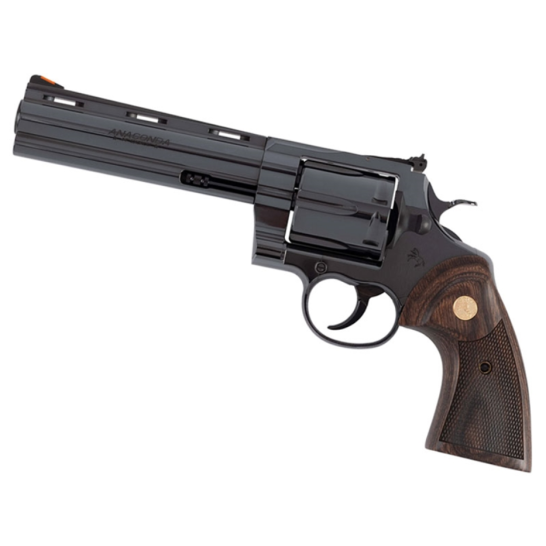
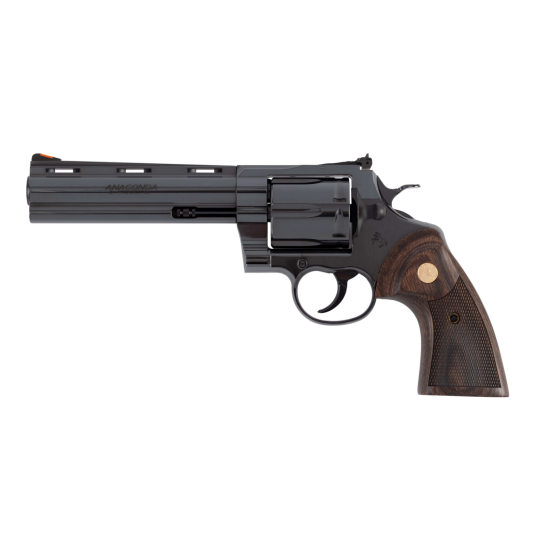
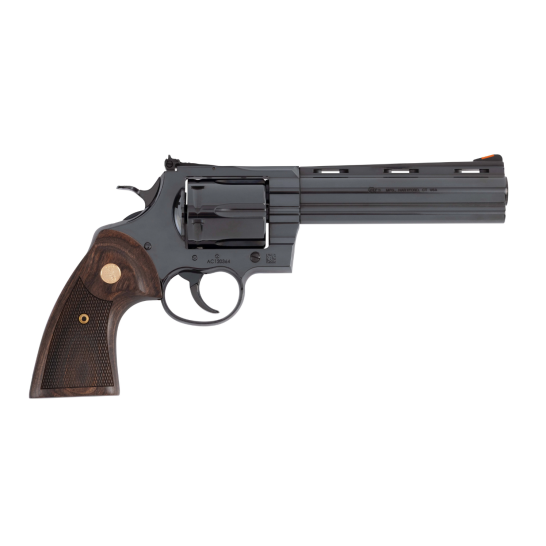

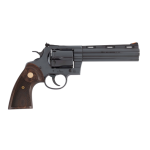


44 magnum revolver
$1,517.99
Details
Brand: Colt
Model/Series: Anaconda
Action: DA/SA
Capacity: 6
Caliber: 44 Mag
Primary Color: Blued
Barrel Length: 6″
Grips: Walnut
Trigger Pull: DA: 8 lbs. SA: 3.5 lbs.
Sights: Red Ramp Front, Adjustable Rear
Overall Length: 13″
Weight: 53 oz
44 Magnum Revolver: History, Models, Features & Complete Guide
The 44 Magnum revolver is one of the most recognisable large-bore revolvers in firearm history.
The cartridge was developed during the 1950s through work involving ammunition manufacturer Remington, Smith & Wesson, and handgunner Elmer Keith. Smith & Wesson completed its first .44 Magnum revolver in 1955. The company later gave the revolver the Model 29 designation in 1957.
The cartridge and revolver quickly became important in hunting, sporting use, collecting, and popular culture.
Today, the .44 Magnum remains associated with famous revolvers such as the Smith & Wesson Model 29, Colt Anaconda, Ruger Redhawk, and Ruger Blackhawk.
This guide explains the history of the .44 Magnum revolver, its major models, design features, different generations, and place in modern revolver history.
What Is a .44 Magnum Revolver?
A .44 Magnum revolver is a revolver chambered for the .44 Remington Magnum cartridge.
Despite the name, the cartridge does not use a true .44-inch projectile diameter. The commonly used bullet diameter is approximately .429 inches.
The .44 Magnum was developed from the .44 Special. The Magnum case was made longer, helping distinguish it from the earlier cartridge and preventing the higher-pressure Magnum cartridge from being used in firearms designed only for .44 Special.
This development created a new class of large-bore Magnum revolvers.
History of the .44 Magnum
The story of the .44 Magnum began before the cartridge officially existed.
During the first half of the 20th century, handgun enthusiasts experimented with increasing the performance of existing revolver cartridges.
One of the most influential figures was Elmer Keith.
Keith spent years developing heavy .44 Special loads and promoting the idea of a more powerful .44-calibre revolver cartridge.
His work eventually attracted the attention of Smith & Wesson and Remington.
Elmer Keith and the .44 Magnum
Elmer Keith played an important role in the development of the .44 Magnum.
He believed the .44 Special could provide greater performance than its factory ammunition suggested.
Keith’s experiments helped demonstrate the potential of the .44-calibre platform. Smith & Wesson and Remington later worked together to create a commercial cartridge based on these ideas.
The result became the .44 Remington Magnum.
The First .44 Magnum Revolver
Smith & Wesson completed the first production .44 Magnum revolver in December 1955.
The company initially marketed the revolver simply as the “.44 Magnum.”
Early versions were available with 4-inch and 6½-inch barrels. An 8⅜-inch option followed later.
The revolver became the foundation for what would later be known as the Model 29.
The Smith & Wesson Model 29
In 1957, Smith & Wesson introduced model numbers for its revolvers.
The .44 Magnum became the Model 29.
It was a large N-frame revolver designed around the .44 Magnum cartridge. The Model 29 became one of the most famous .44 Magnum revolvers ever produced.
Its reputation grew even further during the 1970s.
The .44 Magnum and Dirty Harry
Popular culture played a major role in the fame of the .44 Magnum.
The Smith & Wesson Model 29 appeared prominently in the 1971 film Dirty Harry, starring Clint Eastwood.
The film created enormous public interest in the Model 29 and the .44 Magnum.
Smith & Wesson itself notes that demand for the revolver increased dramatically after the film’s release.
This connection remains one of the strongest examples of popular culture influencing firearm history.
Smith & Wesson Model 29
The Smith & Wesson Model 29 is arguably the most famous .44 Magnum revolver.
It is a six-shot, double-action revolver built around the company’s large N-frame.
Historical versions appeared with several barrel lengths and finishes.
The Model 29 became particularly famous for its polished blue finish, adjustable sights, and large-frame design.
Later versions and related models expanded the range.
Smith & Wesson Model 629
The Model 629 is the stainless-steel counterpart within the broader Model 29 family.
It has become another important name in .44 Magnum revolver history.
The stainless finish gives the revolver a different appearance from traditional blued Model 29 examples.
The Model 629 has also been produced in numerous configurations over the years.
Colt Anaconda
The Colt Anaconda is another major .44 Magnum revolver.
Colt introduced the original Anaconda in 1990.
It was a large-frame double-action revolver with a six-round cylinder and a full-length barrel underlug. It represented Colt’s entry into the large-bore Magnum revolver market.
The original Anaconda was produced mainly in stainless steel.
Colt later discontinued the original production run. However, the Anaconda returned in 2021 with a redesigned action and stronger frame.
The modern Anaconda therefore gives readers two important generations to research.
Ruger Blackhawk .44 Magnum
Ruger was also an early manufacturer of .44 Magnum revolvers.
The company developed a Blackhawk chambered for the new cartridge during the 1950s.
Ruger’s single-action design gave the .44 Magnum another important platform alongside Smith & Wesson’s double-action revolver.
The Ruger Blackhawk became a significant part of the early history of the cartridge.
Ruger has continued producing .44 Magnum revolvers in different forms over the decades.
Ruger Redhawk
The Ruger Redhawk is another well-known .44 Magnum revolver.
Unlike the traditional Blackhawk, the Redhawk uses a double-action design.
Its large frame was developed for powerful cartridges and demanding sporting applications.
The Redhawk has become one of the best-known modern large-frame .44 Magnum revolvers.
It is also an important model for readers comparing different approaches to .44 Magnum revolver design.
.44 Magnum Revolver Design
A .44 Magnum revolver normally requires a substantial frame and cylinder.
The cartridge operates at higher pressure than the older .44 Special.
As a result, manufacturers developed large and robust revolver designs around it.
The Smith & Wesson Model 29, Colt Anaconda, and Ruger Redhawk all demonstrate different approaches to building a large-frame .44 Magnum revolver.
Although their designs differ, they share the need for a suitable frame, cylinder, barrel, and action.
.44 Magnum Cylinder
The cylinder is one of the defining parts of a revolver.
Many classic .44 Magnum revolvers use a six-round cylinder.
The Smith & Wesson Model 29 is a well-known example. Colt’s Anaconda also uses a six-round cylinder.
However, cylinder capacity can vary between revolver designs.
Therefore, readers should check the specifications of the specific model rather than assuming every .44 Magnum revolver has identical capacity.
.44 Magnum Barrel Lengths
Barrel length has varied significantly throughout .44 Magnum history.
Early Smith & Wesson revolvers were offered with 4-inch and 6½-inch barrels. An 8⅜-inch version followed later.
Other manufacturers have produced different barrel lengths over the years.
The Colt Anaconda, for example, has appeared in several barrel lengths across its different generations.
Barrel length is therefore an important search term for anyone researching a specific 44 Magnum model.
Stainless Steel .44 Magnum Revolvers
Stainless steel became increasingly popular among revolver manufacturers.
It provides a distinctive appearance and useful resistance to corrosion.
The Colt Anaconda is strongly associated with stainless-steel construction.
Smith & Wesson also developed stainless versions of its large-frame .44 Magnum revolvers, including the Model 629.
These models provide an interesting contrast with classic blued revolvers.
Blued .44 Magnum Revolvers
Blued steel has a long history in revolver manufacturing.
The classic Smith & Wesson Model 29 is particularly famous for its highly polished blued finish.
This finish became closely associated with the revolver during its early production years.
Collectors often distinguish between different finishes, barrel lengths, and production periods when researching older Model 29 revolvers.
Single-Action vs Double-Action .44 Magnum Revolvers
Not every .44 Magnum revolver uses the same action.
Smith & Wesson’s Model 29 uses a double-action design.
The Colt Anaconda is also a double-action revolver.
By contrast, the Ruger Blackhawk is a famous single-action example.
This difference gives the .44 Magnum category considerable variety.
It also shows why the term “.44 Magnum revolver” describes a broad family rather than one particular firearm design.
.44 Magnum vs .44 Special
The .44 Magnum developed from the .44 Special.
The two cartridges share a common historical lineage, but they are not identical.
The Magnum case is longer than the .44 Special case. This design difference also helps prevent the higher-pressure Magnum cartridge from being chambered in firearms designed only for .44 Special.
Some .44 Magnum revolvers are designed to accept .44 Special ammunition as well.
However, compatibility should always be confirmed using the manufacturer’s specifications for the specific firearm.
.44 Magnum vs .357 Magnum
The .357 Magnum and .44 Magnum are two of the most famous Magnum revolver cartridges.
The .357 Magnum is smaller and has historically been offered in a wider range of revolver sizes.
The .44 Magnum uses a larger cartridge and is generally associated with larger revolvers.
Their histories also developed at different times.
The .357 Magnum appeared in 1935. The .44 Magnum followed roughly two decades later.
Both cartridges became important parts of revolver history, but they occupy different positions in the market.
.44 Magnum vs .45 Colt
The .45 Colt is another historic large-bore revolver cartridge.
It predates the .44 Magnum by many decades.
Modern revolvers can sometimes be chambered for .45 Colt, .44 Magnum, or both depending on the design.
The Colt Anaconda provides an interesting historical example because the original model was later offered in .45 Colt as well as .44 Magnum.
However, cartridge compatibility varies by firearm.
Famous .44 Magnum Revolvers
Several models stand out when researching the history of the .44 Magnum.
Smith & Wesson Model 29
The Model 29 is the most culturally famous .44 Magnum revolver.
It became strongly associated with Dirty Harry and remains an important collector and historical model.
Smith & Wesson Model 629
The Model 629 brought stainless-steel construction to the famous Smith & Wesson large-frame Magnum family.
It has been produced in many configurations.
Colt Anaconda
The Anaconda is Colt’s best-known large-frame .44 Magnum revolver.
Its original production began in 1990, and Colt later revived the model.
Ruger Blackhawk
The Blackhawk is an important single-action .44 Magnum revolver.
Its historical connection to the early Magnum era makes it particularly interesting to collectors and historians.
Ruger Redhawk
The Redhawk is a large-frame double-action revolver designed around powerful cartridges.
It remains an important part of Ruger’s revolver history.
.44 Magnum Revolver Collecting
The .44 Magnum has a strong collector following.
Collectors may focus on specific manufacturers, model variations, production years, finishes, barrel lengths, or historical markings.
Early Smith & Wesson .44 Magnum revolvers are particularly interesting because they represent the beginning of the commercial .44 Magnum era.
Special versions and unusual configurations can also attract attention.
For older revolvers, condition and documented history can be important factors.
Why the .44 Magnum Revolver Remains Famous
The .44 Magnum has survived for decades because of its combination of history and distinctive design.
It helped establish the large-bore Magnum revolver as a major category.
The cartridge also became deeply connected with American popular culture.
At the same time, manufacturers continued developing new revolvers around the cartridge.
That combination of history, engineering, and cultural recognition has kept the .44 Magnum relevant.
Modern .44 Magnum Revolvers
The .44 Magnum is not only a historical cartridge.
Modern manufacturers continue to produce revolvers chambered for it.
Current examples include modern Smith & Wesson, Ruger, and Colt designs.
The modern Colt Anaconda is particularly notable because it revived a historically important model after a long production gap.
Therefore, the.44 Magnum remains a bridge between classic revolvers history and modern manufacturing.
Common 44 Magnum Revolvers Features
Although designs differ, many .44 Magnum revolvers share several broad characteristics.
These may include:
- Large or heavy frame
- Six-round cylinder
- Double-action or single-action operation
- Adjustable sights
- Steel construction
- Multiple barrel lengths
- .44 Magnum chambering
- Compatibility with .44 Special on some models
These features vary by manufacturer and model.
For that reason, a detailed product page should always use the manufacturer’s current specifications.
Frequently Asked Questions
What is a .44 Magnum revolver?
A .44 Magnum revolver is a revolver chambered for the .44 Remington Magnum cartridge.
Who developed the .44 Magnum?
The cartridge resulted from development work involving Elmer Keith, Smith & Wesson, and Remington during the 1950s.
When was the .44 Magnum introduced?
Smith & Wesson completed its first .44 Magnum revolver in 1955, and the revolver was publicly announced in January 1956.
What is the most famous .44 Magnum revolver?
The Smith & Wesson Model 29 is probably the most famous. Its association with Dirty Harry made it a cultural icon.
Is the Colt Anaconda a .44 Magnum revolvers?
Yes. The Colt Anaconda was introduced in 1990 as a large-frame revolver chambered for .44 Magnum.
Is the Ruger Blackhawk available in .44 Magnum?
Yes. Ruger developed a Blackhawk chambered for .44 Magnum during the early years of the cartridge.
Is the Ruger Redhawk a .44 Magnum?
Yes. The Redhawk is a well-known large-frame revolvers that has been chambered for .44 Magnum.
Can a .44 Magnum revolvers use .44 Special?
Some .44 Magnum revolvers are designed to accept .44 Special ammunition. However, users should always verify compatibility with the specific manufacturer’s specifications.
Is the .44 Magnum still produced?
Yes. Manufacturers continue to produce .44 Magnum revolvers.
Is the 44 Magnum the most powerful revolver cartridge?
No. Modern revolvers are available for cartridges larger and more powerful than the .44 Magnum.
The .44 Magnum remains historically important because it helped establish the modern large-bore Magnum revolver category.
Final Thoughts
The .44 Magnum revolver is one of the most important designs in modern revolver history.
Its story began during the 1950s through the work of Elmer Keith, Smith & Wesson, and Remington.
Smith & Wesson’s first .44 Magnum revolver became the Model 29 in 1957. The revolver later achieved worldwide recognition through its association with Dirty Harry.
However, the Model 29 is not the only important .44 Magnum revolver.
The Colt Anaconda, Ruger Blackhawk, Ruger Redhawk, and Smith & Wesson Model 629 all contributed to the cartridge’s history.
Today, the 44 Magnum remains a well-known revolver cartridge with a strong connection to collecting, sporting history, firearm design, and popular culture.


Reviews
There are no reviews yet.