


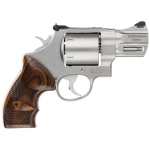
magnum revolver
Original price was: $1,684.99.$1,517.99Current price is: $1,517.99.
Details
Manufacturer: Colt
Product Line: Anaconda
Caliber: .44 Magnum
Capacity: 6 Rounds
Barrel Length: 8″
Overall Length: 15″
Rear Sight: Adjustable
Front Sight: Red Ramp
Finish: Stainless
Magnum Revolver: History, Types, Calibers & Complete Guide
A magnum revolver is a revolver chambered for a cartridge that belongs to the magnum family. These cartridges were developed to provide higher performance than earlier standard cartridges.
The term “magnum” became strongly associated with powerful revolvers during the 20th century. The .357 Magnum arrived in 1935, followed by the .44 Magnum in the 1950s.
Since then, manufacturers have produced magnum revolvers in many sizes and calibers. These include compact .357 Magnum revolvers, large .44 Magnum models, and much larger revolvers chambered for modern high-pressure cartridges.
Today, the magnum revolver remains an important part of firearm history and revolver design.
What Is a Magnum Revolver?
A magnum revolver is a revolver designed to fire a cartridge marketed or designated as a magnum.
The word “magnum” does not describe one specific caliber. Instead, it appears in the names of many different cartridges.
For example, .357 Magnum and .44 Magnum are both magnum cartridges. However, they differ considerably in size, design, recoil, and historical development.
Therefore, a magnum revolver can range from a relatively compact handgun to a very large, heavy revolver.
History of Magnum Revolvers
The history of magnum revolvers began during the early 20th century.
At the time, shooters and firearm designers were interested in improving the performance of existing handgun cartridges. Advances in metallurgy and smokeless powder helped make stronger revolvers and higher-pressure ammunition possible.
This development eventually created the modern magnum era.
The .357 Magnum
The .357 Magnum was introduced in 1935.
Smith & Wesson worked with ammunition experts including Phil Sharpe, Elmer Keith, and Winchester during its development. The cartridge used a longer case than the .38 Special and was designed for higher performance.
The first Smith & Wesson .357 Magnum was known as the Registered Magnum. It later became associated with the Model 27.
The introduction of the .357 Magnum established the basic idea of the modern magnum revolver.
The .44 Magnum
The .44 Magnum followed in the 1950s.
Elmer Keith had spent years experimenting with the .44 Special. His work helped demonstrate the potential for a more powerful .44-caliber revolver cartridge.
Smith & Wesson and ammunition manufacturer Remington then developed the .44 Magnum concept.
The cartridge was introduced commercially in 1956. Smith & Wesson’s Model 29 became its most famous early revolver.
The .44 Magnum later became a major part of popular culture through films such as Dirty Harry.
Why Are Magnum Revolvers Important?
Magnum revolvers are important because they pushed revolver design into a new performance category.
They required stronger frames, cylinders, and other components.
Manufacturers also had to consider the relationship between cartridge pressure, revolver size, weight, and durability.
As a result, magnum revolvers helped drive advances in revolver engineering.
They also created new categories of sporting, hunting, target, and historical firearms.
.357 Magnum Revolvers
The .357 Magnum is one of the most widely recognised magnum revolver cartridges.
It has been chambered in revolvers ranging from compact models to large target-oriented designs.
Classic examples include the Smith & Wesson Model 27 and Model 19. Colt also produced famous .357 Magnum revolvers, including the Python.
The .357 Magnum became particularly important because it offered substantially greater performance than the .38 Special while fitting into a broad range of revolver designs.
That versatility helped make the cartridge a long-term part of revolver history.
.44 Magnum Revolvers
The .44 Magnum represents a different category.
It is a larger cartridge that normally requires a larger revolver.
The Smith & Wesson Model 29 is one of the most famous .44 Magnum revolvers in history. The cartridge is also associated with models from Colt, Ruger, and other manufacturers.
The .44 Magnum became especially famous after its appearance in popular culture during the 1970s.
However, its importance goes beyond films. It became a significant cartridge for sporting and hunting applications.
Other Magnum Revolver Calibers
The magnum revolver category extends well beyond .357 and .44 Magnum.
Other examples include:
- .41 Magnum
- .454 Casull
- .460 S&W Magnum
- .500 S&W Magnum
- .480 Ruger
- .327 Federal Magnum
These cartridges have different dimensions and performance characteristics.
Therefore, it is not accurate to describe every magnum revolver as simply a more powerful version of a .357 or .44.
Each cartridge requires a suitable firearm design.
.41 Magnum Revolvers
The .41 Magnum was introduced during the 1960s.
It was developed as an intermediate option between the .357 Magnum and .44 Magnum.
Smith & Wesson produced several revolvers for the cartridge.
The .41 Magnum never achieved the same cultural popularity as the .357 or .44 Magnum. Nevertheless, it has an important place in magnum revolver history.
Modern Large-Caliber Magnum Revolvers
Modern engineering has allowed manufacturers to produce extremely large revolvers.
Examples include revolvers chambered for .454 Casull, .460 S&W Magnum, and .500 S&W Magnum.
These cartridges operate at substantially different levels from traditional revolver cartridges.
Consequently, the revolvers designed for them are usually larger and heavier.
The development of these firearms demonstrates how far revolver engineering has progressed since the introduction of the .357 Magnum.
Magnum Revolver Frame Sizes
Frame size is an important part of revolver design.
A revolver frame supports the barrel, cylinder, and internal action. Larger cartridges generally require designs capable of handling their pressure and physical dimensions.
Smith & Wesson provides a useful example.
The company’s K-frame became associated with medium-size .357 Magnum revolvers. Later, the larger L-frame was developed to provide a stronger platform for sustained .357 Magnum use.
The even larger N-frame became strongly associated with cartridges such as the .44 Magnum.
This shows why cartridge choice and revolver size are closely connected.
Magnum Revolver Cylinder
The cylinder is one of the defining components of any revolver.
It contains the individual chambers for the cartridges.
Magnum revolvers can have different cylinder capacities depending on their size and cartridge.
For example, traditional large-frame .44 Magnum revolvers commonly use six-shot cylinders. Some smaller or specialised designs use five shots, while other magnum revolvers can hold more.
Therefore, cylinder capacity should always be considered alongside the revolver’s frame size and cartridge.
Magnum Revolver Barrel Lengths
Magnum revolvers have been produced with many different barrel lengths.
Historical .357 Magnum revolvers were available with barrel lengths ranging from relatively short configurations to very long target-style barrels.
Modern revolvers also come in a wide range of sizes.
A shorter barrel can make a revolver more compact. A longer barrel can provide a longer sight radius and change the overall balance of the firearm.
For historical and SEO content, it is best to discuss these differences without treating one barrel length as universally superior.
Stainless Steel Magnum Revolvers
Stainless steel became increasingly popular in modern revolver design.
It provides a distinctive appearance and can offer useful corrosion-resistance characteristics compared with traditional blued carbon steel.
Many modern .357 and .44 Magnum revolvers are available in stainless or other corrosion-resistant finishes.
Colt’s Anaconda is a well-known example of a large stainless-steel Magnum revolver.
Blued Magnum Revolvers
Blued steel has a long history in revolver manufacturing.
Many classic magnum revolvers were produced with polished blue finishes.
The Smith & Wesson Model 27, for example, became famous for its highly polished blued finish. Early Registered Magnum revolvers were also produced with a polished blue finish.
Blued finishes remain popular among collectors because they connect modern firearms with traditional revolver design.
Double-Action Magnum Revolvers
Many modern magnum revolvers use a double-action mechanism.
A double-action revolver can generally be fired by pressing the trigger through the complete firing cycle. It can also normally be operated in single-action mode by manually cocking the hammer.
The exact design varies between manufacturers and models.
Colt, Smith & Wesson, Ruger, and other manufacturers have developed their own approaches to double-action revolver mechanisms.
Magnum Revolver vs Standard Revolver
The main difference between a magnum revolver and a standard revolver is the cartridge designation.
A standard revolver may use cartridges such as .38 Special or .45 Colt.
A magnum revolver may use .357 Magnum, .44 Magnum, .41 Magnum, or another cartridge carrying the Magnum designation.
However, the difference is not simply about power.
Magnum cartridges can require different frame sizes, cylinder designs, materials, and engineering solutions.
Therefore, the revolver and cartridge must be considered as one system.
.357 Magnum vs .44 Magnum
The .357 Magnum and .44 Magnum are two of the most famous magnum cartridges.
The .357 Magnum is smaller and has historically been offered in a wider range of revolver sizes.
The .44 Magnum is larger and became strongly associated with large-frame revolvers.
Their histories are also different.
The .357 Magnum appeared in 1935, while the .44 Magnum was introduced in the mid-1950s.
Both cartridges became influential, but they occupy different places within revolver history.
Famous Magnum Revolvers
Several revolvers have become particularly important to firearm history.
Smith & Wesson Model 27
The Model 27 traces its history to the original Registered Magnum.
It became one of the company’s most famous .357 Magnum revolvers.
Smith & Wesson Model 19
The Model 19 was introduced as a more compact .357 Magnum design.
It became closely associated with the company’s Combat Magnum concept.
Smith & Wesson Model 29
The Model 29 is one of the most famous .44 Magnum revolvers.
Its popularity increased dramatically after its association with Dirty Harry.
Colt Python
The Colt Python is primarily associated with .357 Magnum.
Its ventilated rib and distinctive appearance have made it one of Colt’s most recognisable revolvers.
Colt Anaconda
The Colt Anaconda is a large-frame revolver strongly associated with .44 Magnum.
Its original production began in 1990, and Colt later reintroduced the model.
Ruger Super Redhawk
The Super Redhawk is another well-known large-frame revolver platform.
Ruger has offered the design in several powerful cartridges.
Magnum Revolvers in Popular Culture
Magnum revolvers have had a major role in film and television.
The .44 Magnum became particularly famous after the Smith & Wesson Model 29 appeared prominently in Dirty Harry.
The association between the film and the cartridge helped turn the .44 Magnum into a cultural icon.
The .357 Magnum has also appeared frequently in crime films, television programmes, and historical dramas.
This media exposure helped introduce revolver terminology to audiences who had little knowledge of firearms.
Magnum Revolvers and Collecting
Magnum revolvers have become important collector firearms.
Collectors may focus on specific manufacturers, model generations, finishes, barrel lengths, production dates, or historical variations.
For example, early Smith & Wesson Registered Magnums are particularly interesting because of their limited production and individual registration history.
Classic Colt and Smith & Wesson revolvers can also attract interest because of their historical significance.
When researching a collectible revolver, documentation and provenance can be as important as the basic model name.
Magnum Revolver Terminology
Understanding common terminology makes it easier to research these firearms.
Magnum: A cartridge designation generally associated with a higher-performance cartridge within its family.
Frame: The main structural body of the revolver.
Cylinder: The rotating component containing the chambers.
Barrel: The tube through which the projectile travels.
Double action: A revolver action that combines trigger movement with the hammer or internal firing mechanism.
Single action: An action in which the hammer is manually cocked before the trigger releases it.
Underlug: A section beneath the barrel that commonly houses or protects the ejector rod.
N–frame: A large Smith & Wesson frame historically associated with powerful cartridges.
These terms are useful for readers comparing different magnum revolvers.
Are All Magnum Revolvers Large?
No.
This is an important point.
A .357 Magnum can be chambered in relatively compact revolvers as well as larger models.
By contrast, very large cartridges such as .500 S&W Magnum require substantially larger revolver designs.
Therefore, the term “magnum revolver” covers a wide range of firearm sizes.
Are Magnum Revolvers Still Relevant?
Yes.
Although semi-automatic pistols dominate many modern handgun markets, magnum revolvers remain relevant as sporting, collecting, historical, and recreational firearms.
Manufacturers continue to produce new revolvers in .357 Magnum, .44 Magnum, and other magnum cartridges.
The continued production of these models also reflects the lasting appeal of the revolver design.
Frequently Asked Questions
What is a magnum revolver?
A magnum revolver is a revolver chambered for a cartridge carrying the Magnum designation, such as .357 Magnum or .44 Magnum.
What was the first Magnum revolver?
The Smith & Wesson Registered Magnum, introduced in 1935, is generally recognised as the first revolver chambered for .357 Magnum.
What is the most famous Magnum revolver?
The Smith & Wesson Model 29 is one of the most famous because of its association with the .44 Magnum and Dirty Harry.
What is the difference between .357 Magnum and .44 Magnum?
The .357 Magnum and .44 Magnum are different cartridges with different dimensions and performance characteristics. The .44 Magnum is the larger cartridge and is generally associated with larger revolvers.
Are all Magnum revolvers .357 Magnum?
No. Magnum revolvers can be chambered for many different cartridges.
Examples include .357 Magnum, .41 Magnum, .44 Magnum, .454 Casull, .460 S&W Magnum, and .500 S&W Magnum.
Are Magnum revolvers still made?
Yes. Major manufacturers continue to produce revolvers chambered for several Magnum cartridges.
Why are Magnum revolvers usually heavier?
Larger Magnum cartridges can require stronger and larger firearm designs. The additional material can also help manage the stresses associated with these cartridges.
Is the .44 Magnum the most powerful Magnum revolver cartridge?
No. Larger modern cartridges such as .454 Casull, .460 S&W Magnum, and .500 S&W Magnum exceed the .44 Magnum in several performance measures.
The .44 Magnum remains historically important because it was one of the first widely successful large-bore Magnum handgun cartridges.
Final Thoughts
The magnum revolver has played an important role in modern handgun history.
The introduction of the .357 Magnum in 1935 established a new class of high-performance revolvers. More than two decades later, the .44 Magnum expanded that idea into a larger cartridge and revolver platform.
Since then, manufacturers have developed many other Magnum cartridges.
Today, the term covers everything from compact .357 Magnum revolvers to extremely large revolvers designed for cartridges such as .500 S&W Magnum.
The most important point is that there is no single “Magnum revolver.” Instead, the category includes many designs, manufacturers, frame sizes, cartridges, and historical periods.
That variety makes Magnum revolvers an excellent subject for an evergreen educational resource.


Reviews
There are no reviews yet.